Ayşenur Taştemel — Interior Architect - Corporate Marketing Manager

Underfloor heating has become the default in many new builds and renovations across Europe and North America — and it changes the flooring question. The wrong floor over a heated subfloor can mean gaps opening between boards, slow-to-warm rooms, and wasted energy. So the question we hear most often each winter is simple: "Can I put SPC flooring over underfloor heating?"
The short answer: Yes — SPC flooring is suitable for underfloor heating, as long as the floor surface temperature stays at or below 28 °C (82 °F). This guide explains what the 28 °C rule really means, which heating systems SPC works with, and exactly what to do before, during, and after installation.
Is SPC Flooring Suitable for Underfloor Heating? The Short Answer
SPC (Stone Plastic Composite) flooring has a rigid, dense core made by bonding limestone powder and PVC under high pressure. That structure gives it three real advantages over a heated subfloor:
- Good heat transfer: The thin, dense core carries heat to the surface quickly, so rooms warm up faster.
- Dimensional stability: Unlike solid wood, it doesn't dry out and crack, and it moves far less than laminate as temperatures change.
- 100% waterproof: With wet (hydronic) systems, a leak or residual moisture in the screed won't make SPC swell.
Porfloor's SPC flooring installation guide sets a maximum temperature of 28 °C over underfloor heating. Stay within that limit and SPC can be used with confidence in heated spaces.
The 28 °C Rule: What Does It Actually Mean?
The most common mistake is confusing 28 °C with the boiler setting or the water temperature in the pipes. 28 °C is the temperature measured on the top surface of the floor. The flow water can be warmer than that; what matters is that, once the heat has passed through the screed and the flooring, the surface doesn't exceed this value.
Why does the limit matter?
- SPC's core contains PVC. PVC-based materials expand under excessive heat, and prolonged high temperatures can put stress on the click-lock joints and lead to gaps between boards.
- Going higher doesn't add comfort either. A comfortable floor temperature in living areas is typically 24–27 °C, so 28 °C is already at the top of that range.
Practical tip: Use a thermostat with a floor sensor wherever possible. A thermostat that only reads room air temperature has no idea how warm the floor surface is getting. A floor sensor is the most reliable way to hold the 28 °C limit automatically.
Which Underfloor Heating Systems Is SPC Compatible With?
| Heating system | Compatibility with SPC | What to watch |
|---|---|---|
| Wet (hydronic) underfloor heating in screed | Suitable — the most common and best-matched combination | Surface temperature must not exceed 28 °C |
| Electric cable system in screed | Suitable | A floor-sensor thermostat is essential |
| Electric heating film / foil directly under the flooring | Use with caution | Risk of hot spots; consult the manufacturer before installing |
Wet (hydronic) systems spread heat evenly through the screed, which is why they pair most reliably with SPC. Electric cables embedded in the screed also work well when properly controlled by a thermostat. With heating films laid directly beneath the flooring, heat can concentrate in spots — if you're planning that type of system, please get in touch with us before you choose it.
Before Installation: Prepare the Heating System and Subfloor
Most of the success of a floor over underfloor heating is decided before the first board goes down.
- The screed must be fully dry. If the screed is new, don't lay flooring until it has fully cured. Moisture in the screed moves upward once the heating comes on. Your screed supplier or flooring installer can confirm the residual moisture with a meter reading.
- The heating system must be tested. Run the system at least once before installation so any leaks or faults are found before the floor is down. With new screeds, the commissioning (heat-up) programme recommended by your heating engineer should be complete.
- Switch the heating off 48 hours before installation. Porfloor's installation guide requires it. Boards laid on a warm screed can shrink as they cool and open up gaps.
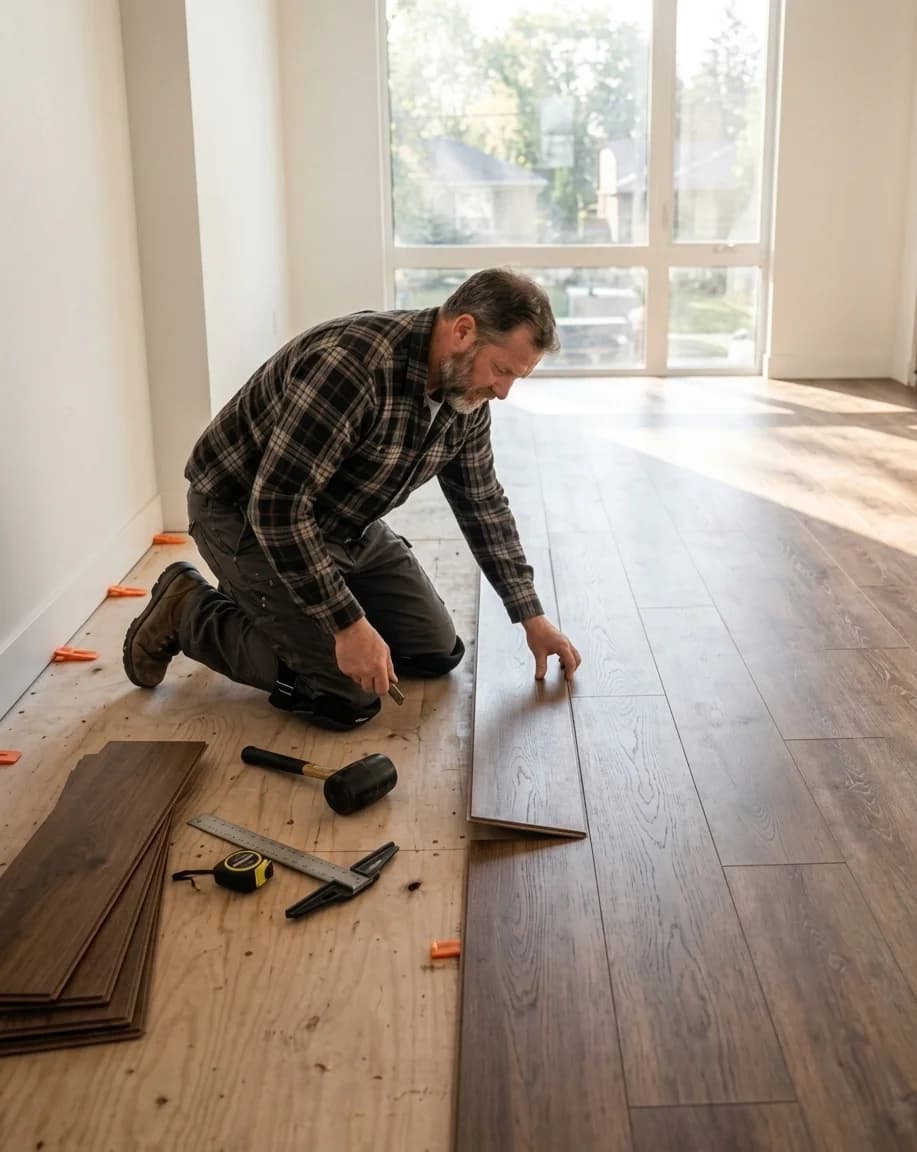
- Acclimate the flooring. Leave the unopened boxes in the room where they'll be installed for at least 24 hours. (See our step-by-step DIY installation guide for details.)
- Check the subfloor is flat. For the click-lock system to engage properly, the subfloor must be clean, dry, and level.
During Installation: What to Watch
- Don't add a thick extra underlay. The "+1 mm" in Porfloor's SPC flooring (4+1, 5+1, 6+1 mm) refers to the underlay layer integrated into the back of the board. Adding thick foam, cork, or carpet underlay beneath it slows heat reaching the surface. As a general rule, the combined thermal resistance of the flooring and underlay over underfloor heating should stay below 0.15 m²K/W.
- Always leave an expansion gap. A gap of roughly 1 cm around the walls lets the warming floor move freely.
- No nails, screws, or glue. SPC is laid as a floating floor that clicks together. Over underfloor heating, that's an extra safeguard: nothing is fixed into the screed, so there's no risk of piercing pipes or cables.
- Don't skip the moisture barrier. Over screed, using a damp-proof membrane (PE film) in line with the manufacturer's instructions protects the floor in the long run.
If you're replacing an old floor without ripping it out, our guide to renovating without demolition will also help.
After Installation: How to Turn the Heating Back On
When installation is finished, don't switch the heating straight to full power.
- Keep the heating off for 7 days. Porfloor's installation guide requires this so the boards can settle. If you're installing in winter, plan the job around it.
- Start low. Restart the system on its lowest setting.
- Increase gradually. Raise the temperature by 1–2 °C per day until you reach normal operating temperature.
- Never exceed 28 °C at the surface. Avoid sudden temperature changes, and use the same gradual approach whenever you switch the heating off and on at the start and end of the season.
Choosing a Thickness: 4+1, 5+1, or 6+1 mm?
Porfloor's wood-look SPC flooring comes in 4+1, 5+1, and 6+1 mm, and our stone-look SPC flooring in 4+1 and 5+1 mm. From an underfloor heating perspective:
- Thinner boards (4+1 mm) transfer heat to the surface faster, so rooms warm up more quickly.
- Thicker boards (5+1 and 6+1 mm) offer a more rigid build and a more solid feel underfoot. They transfer heat slightly more slowly but remain suitable for underfloor heating.
If heating performance is your top priority at home, thinner boards are the natural pick; for high-traffic and commercial spaces, thicker boards come into their own. Explore our wood-look SPC flooring collections and stone-look SPC flooring collections for designs.
SPC vs. Laminate, Solid Wood, and Tile Over Underfloor Heating
| Feature | SPC flooring | Laminate | Solid wood | Ceramic / porcelain tile |
|---|---|---|---|---|
| Underfloor heating compatibility | Suitable (max. 28 °C surface) | Usually suitable, with temperature limits | Risky — drying and cracking | Excellent |
| Heat transfer | Good | Moderate | Low | Excellent |
| Water / moisture resistance | 100% waterproof | Can swell with water | Sensitive to water | Waterproof (grout needs upkeep) |
| Movement with temperature | Low | Moderate | High | Very low |
| Feel underfoot | Warm and comfortable | Warm | Warm | Cold when heating is off |
| Installation | Click-lock, over existing floors | Click-lock | Skilled labour | Screed, adhesive, grout — takes days |
Tile is the best conductor of heat, but it's cold underfoot when the heating is off and takes days to install. SPC combines good heat transfer, a warm feel underfoot, and complete waterproofing. For deeper comparisons, see SPC vs. laminate and SPC vs. ceramic tile.
Common Mistakes With Heated Floors
- Confusing the boiler setting with the surface temperature. The limit is 28 °C measured on the floor surface.
- Installing with the heating on. Boards laid on a warm floor can open up gaps as they cool.
- Adding thick rugs or underlays. Thick rugs and extra underlays trap heat, cause local heat build-up at the surface, and push up energy use.
- Switching straight to full power. Always raise the temperature gradually.
- Skipping the expansion gap. A warming floor with nowhere to move can lift or peak.
Frequently Asked Questions
Is SPC flooring suitable for underfloor heating? Yes. SPC flooring's thin, dense core conducts heat well, so it can be used over underfloor heating. The one condition is that the floor surface temperature must not exceed 28 °C (82 °F). Porfloor's SPC flooring installation guide also sets a maximum temperature of 28 °C over underfloor heating.
What does the 28 °C limit actually refer to? 28 °C is the temperature measured on the top surface of the floor — not the boiler setting or the water temperature in the pipes. The safest way to stay within it is a thermostat with a floor sensor.
Can SPC flooring go over electric underfloor heating? Electric cable systems embedded in the screed are suitable as long as they are controlled by a thermostat with a floor sensor. With heating films or foils laid directly beneath the flooring, hot spots can occur, so check with the manufacturer before installation.
How should I prepare a heated subfloor before laying SPC? New screed must be fully cured and dry, and the heating system must have been run and tested at least once. Switch the heating off 48 hours before installation, and leave the boxed flooring in the room for at least 24 hours.
When can I turn the underfloor heating back on after installation? Porfloor's installation guide requires the heating to stay off for 7 days after installation. Then restart the system at a low temperature and raise it by 1–2 °C per day until you reach normal operating temperature. Avoid sudden temperature changes.
Is SPC or laminate better over underfloor heating? Both can be used within the right temperature limits. But SPC is fully waterproof, so a pipe leak or damp screed won't make it swell, whereas laminate's HDF core can swell on contact with water.
Conclusion
With good heat transfer, dimensional stability, and 100% waterproofing, SPC is one of the most sensible flooring choices for homes with underfloor heating. The keys to success are simple: keep the surface below 28 °C, turn the heating down before installation, and bring it back up gradually afterwards.
To choose the right design and thickness for your heated floor project, explore Porfloor's SPC flooring collections, request our catalogue, or get in touch with any technical questions.